Following the discussion about Wagtail
(my contribution: https://admin.ki-leierbud.lu/archives/2154 ),
I would like to add some further information and comments:
Mini-Applications
The most well-known ecosystems of mini-applications are the App Store and Google Play.
In the field of AI, the majority of projects are mini-applications.
On HuggingFace alone, the largest AI platform used by more than 1.2 million users, the statistics show 600,000 Spaces (= mini-applications), more than 1.7 million AI models, over 20,000 datasets, and more than 50,000 organizations using HuggingFace’s paid services.
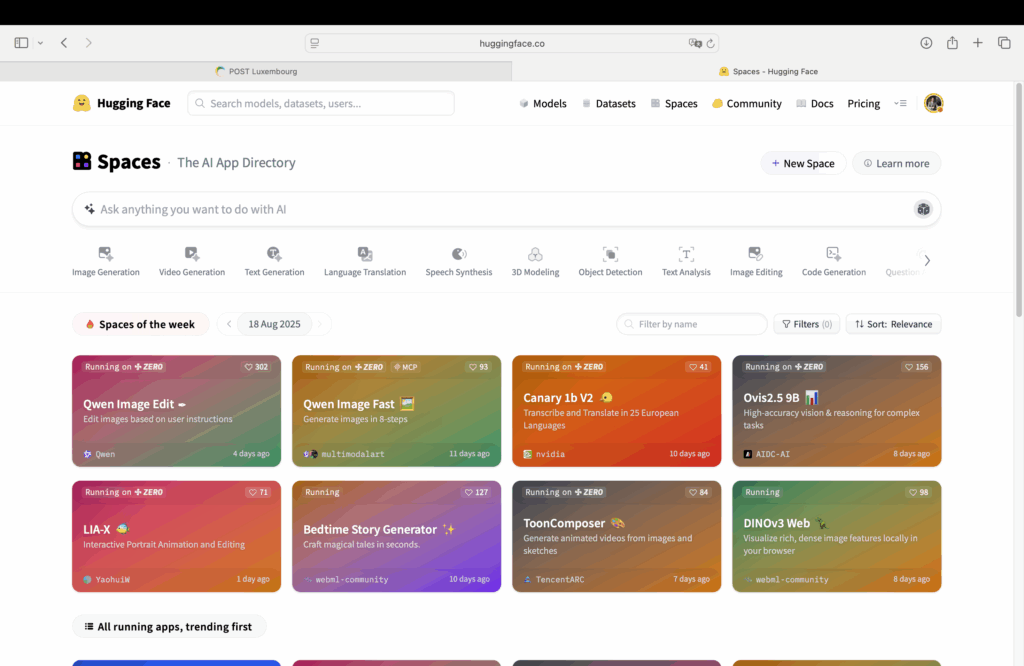
Other examples of AI ecosystems include OpenAI’s custom GPTs, Lovable communities, LetzAI’s Playground, and many other companies and organizations.
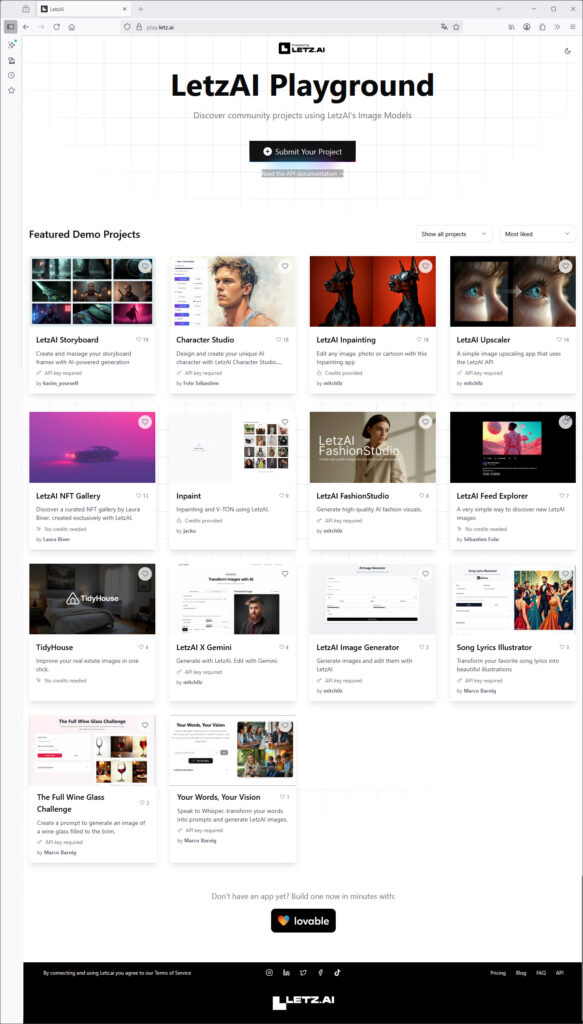
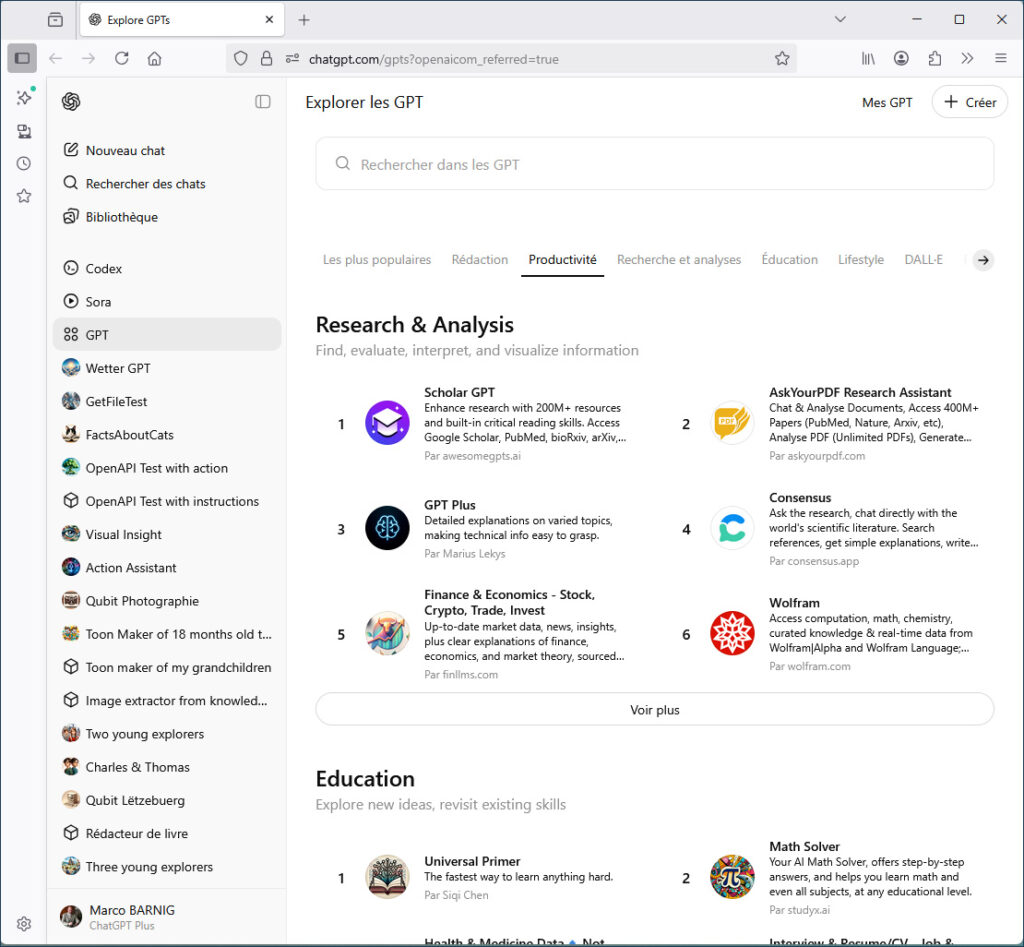
Compilation of Mini-Applications
With the command npm run build, one can compile a REACT application into a /dist folder containing an index.html, an /assets/xyz.css, and an /assets/xyz.js. This mini-application can then be run in a browser locally, on a small local Python server, or stored in the root folder of the PLESK server (in a subdomain or hierarchical folder). I tested both variants.
After the launch of ChatGPT-5, I asked the AI to code a prototype of a “Knowledge” mini-application directly in HTML, CSS, and JS, without going through React source files (.jsx, .tsx, etc.). This works, but ChatGPT-5 advises against it because one cannot benefit from the full power of the REACT ecosystem.
For hosting the mix of mini-applications coded with the two methods, I currently use the following file structure:
project-root/                                    /* httpdocs */
  index.html                                      /* landing page */
  toc.html                                          /* dashboard */
  about.html
  faq.html
  search.html
  login.html
 └─ operations/
 │       ├─ login/
 │        │   └─ index.html
 │       └─ search/
 │            └─ index.html
 │       ├─ section/                           /* knowledge */
 │            └─ app-name-1/             /* mini-app-1 */
 │                  ├─ index.html
 │                   └─ assets/ (...)
 │             └─ app-name-2/           /* mini-app-2 */
 │                   ├─ index.html
 │                   └─ assets/ (...)
 │             └─ app-name-3/           /* mini-app-3 */
 │                   ├─ index.html
 │                   └─ assets/ (...)
 │    ..........
 │
 │         ├─ section/                         /* quiz */
 │             └─ app-name-n/
 │                   ├─ index.html
 │                   └─ assets/ (...)
 │             └─ app-name-n+1/
 │                  ├─ index.html
 │                  └─ assets/ (...)
 │  .........
I am discussing with Misch to determine the most appropriate implementation of mini-applications while considering all constraints.
Creation and Hosting of Mini-Applications on HuggingFace
During the initial partner discussions, I suggested using HuggingFace as a platform for creating and hosting mini-applications for the KI-Léierbud portal, alongside LetzAI’s AI platforms. This idea is also included in the documents submitted to the Ministry of Digitalisation as part of our proposal.
I have a HuggingFace PRO account which costs $9 per month and allows the creation and hosting of an unlimited number of Spaces. A Space can be created with Gradio (=Python), Docker, or static templates. Spaces provide an API to connect them to a frontend. Limited shared GPU usage (ZeroGPU Space) is included in the PRO subscription.
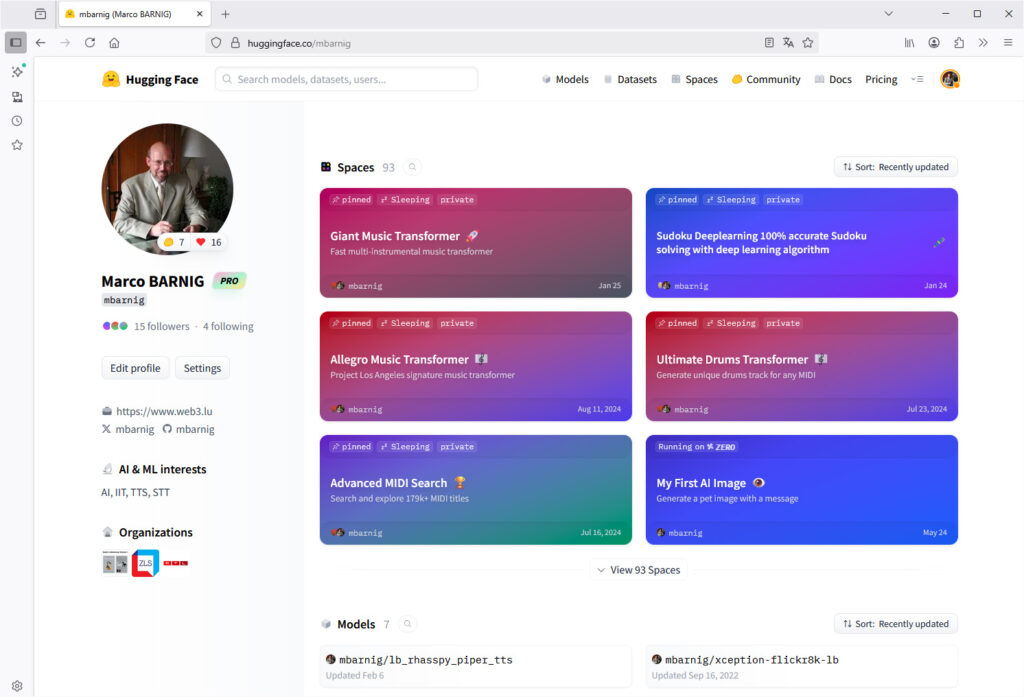
So far, I have created 93 Spaces on HuggingFace, the majority of which are private Gradio applications not accessible to the public. I have developed prototypes for the KI-Léierbud project using the HuggingFace API, for example :
- https://huggingface.co/spaces/mbarnig/My_first_AI_Image
- https://huggingface.co/spaces/rtllu/RTL_Multilingual_News_Reader
- https://github.com/mbarnig/Text_to_Avatar
I created additional spaces in the HuggingFace accounts of RTL and of the ZLS (Zenter fir Lëtzebuerger Sprooch). The RTL mini apps are related to news-searching (inside several GigaBytes of JSON archives from the RTL Internet website stored on my PC) and to interactive avatars. The ZLS mini-apps are related to my STT and TTS development of models for speech transcription and synthesis which are now in production since several months.
I would like to revive the idea of using HuggingFace to create and host mini-applications for KI-Léierbud, to be included in the portal’s Landing Page and Dashboard.
Because if you can do more, you can certainly do less. A HuggingFace Space can host a mini-application without relying on an AI model—for example, a quiz or a poll—entirely independent of WordPress. With Python, such a mini-application can be built in just a few hours.
I created one example of this option to make it easier to understand. Here are the links to the HuggingFace space and to my explanations about the development :
https://huggingface.co/spaces/mbarnig/KI-Leierbud-Quiz
https://admin.ki-leierbud.lu/archives/2277
Why use independent (stand-alone) mini-applications?
- Different technologies can be used to build mini-applications.
- Mini-applications developed by external developers can be integrated (example: AI-Agent-Café).
- External developers’ code can be reused to develop a mini-application (example: Lux-ASR from uni.lu).
- Maintenance and extension of a mini-application are simplified.
- It’s easy to create individual mini-apps for the different languages by modifying only the text and the labels inside the code
- Mini-applications can be distributed and shared outside the KI-Léierbud framework.
- Mini-applications can be converted into mobile applications and distributed via the App Store and Google Play (example: Lux-ASR apps from uni.lu – https://www.linkedin.com/posts/petergilles_luxasr-ugcPost-7343571044714131456-PnX_ )
KI-Léierbud flagship mini-application (bonus)
The flagship mini-application of KI-Léierbud, planned to allow users to create a personal story and print it on a digital publishing platform, will very likely also be offered as a mobile application in the corresponding ecosystems.