Knowledge
De Nordwand an d’Sonn : TTS
De Nordwand and d’Sonn is the beginning of the Luxembourgish translation of one of Aesop’s fables, taken from a collection of prose fables attributed to the Greek writer Aesop.
Aesop’s fables consist of hundreds of texts and all kinds of stories that were passed down orally in ancient Greece and have inspired many authors such as Phaedrus, Marie de France, and Jean de La Fontaine. The Aesop fable De Norwand an d’Sonn is very short; its moral lies in the lesson that persuasion, although slower, proves to be more effective than violence. This fable has been translated into hundreds of world and regional languages. The texts of this fable are regularly used by linguists in research projects on natural language processing (NLP).
In May 2025, HeyGen announced the launch of a new AI Text-to-Speech system with the support of additional languages, including Luxembourgish. I used the Luxembourgish version of Aesops fable, reproduced below, to test the performance of 4 public HeyGen avatars during the generation of videos, using the speech synthesis of our national language.
An der Zäit hunn sech den Nordwand an d’Sonn gestridden, wie vun hinnen zwee wuel méi staark wier, wéi e Wanderer, deen an ee waarme Mantel agepak war, iwwert de Wee koum. Si goufen sech eens, datt deejéinege fir dee Stäerkste gëlle sollt, deen de Wanderer forcéiere géif, säi Mantel auszedoen. Den Nordwand huet mat aller Force geblosen, awer wat e méi geblosen huet, wat de Wanderer sech méi a säi Mantel agewéckelt huet. Um Enn huet den Nordwand säi Kampf opginn. Dunn huet d’Sonn d’Loft mat hire frëndleche Strale gewiermt, a schonn no kuerzer Zäit huet de Wanderer säi Mantel ausgedoen. Do huet den Nordwand missen zouginn, datt d’Sonn vun hinnen zwee dee Stäerkste wier.
Which of the five avatars shown in the next pages — Annie, Lisa, Sophie, Masha or Gala — has the best mastery?
ERNIE-ViLG
ERNIE‑ViLG is Baidu’s flagship Chinese text-to-image model, capable, culturally aware, and technically advanced, especially with its diffusion-based architecture and denoising experts in version 2. Despite strong results, it’s moderated for sensitive content and optimised for Chinese-language use.
🚀 Origins & Versions
- ERNIE‑ViLG v1 (Dec 2021): Introduced as a bidirectional vision-language transformer, trained on Chinese image-text pairs; about 10 billion parameters.
- ERNIE‑ViLG 2.0 (Oct 2022): Upgraded to a diffusion model with ~24 billion parameters and a novel “mixture-of-denoising-experts” approach.
GANs
Generative Adversarial Networks are a type of neural network architecture invented in 2014 by Ian Goodfellow and his collaborators. GANs are foundational to much of today’s AI image generation.
A GAN is made of two neural networks that play a game:
| Component | Role |
|---|---|
| Generator (G) | Tries to create fake data that looks like real data (e.g., fake images). |
| Discriminator (D) | Tries to tell real from fake — it acts like a critic or detective. |
They train together:
- The generator creates an image.
- The discriminator decides if it’s fake or real.
- Feedback from the discriminator helps the generator improve.
- Over time, the generator gets so good the discriminator can’t tell the difference.
This is why it’s called adversarial — the two networks are in a constant battle.
GANs are unsupervised (or self-supervised) learning models — they don’t need labeled data.
They learn the distribution of training data and generate new data from that distribution.
Many improved GANs have been developed since 2014, including:
| Variant | Purpose |
|---|---|
| DCGAN (2015) | Deep Convolutional GAN — popular for image generation |
| StyleGAN (2018–2021) | Introduced “style” control — used in “This Person Does Not Exist” |
| CycleGAN | Image-to-image translation (e.g., horses ↔ zebras) |
| BigGAN | High-quality, class-conditional image generation (from ImageNet) |
StyleGAN
StyleGAN, developed by NVIDIA Research, is a groundbreaking architecture for generating ultra-realistic synthetic images, especially of human faces. Its ability to control “styles” across image layers set a new standard in AI image generation and led to viral real World applications like This Person Does Not Exist. Today, it’s used across art, games, fashion, and media, with both exciting and troubling implications.
The lead authors are Tero Karras, Samuli Laine and Timo Aila. Unlike earlier GANs, which often had limited control over image attributes, StyleGAN introduced a “style-based” architecture that revolutionized image synthesis. Images are generated in a multi-scale, layered way : High-level (pose, identity, …), mid-level (features like eye shape, …), low-level (color, texture, …). A latent input vector is transformed into an intermediate latent space (W space).
The following list presents the timescale of the launch of different StyleGAN versions :
🔹 StyleGAN1 (2018)
- Introduced style-based generation
- Produced realistic but occasionally distorted faces
🔹 StyleGAN2 (2019–2020)
- Major quality improvement
- Fixed artifacts and strange features in faces (e.g., weird teeth or asymmetry)
- Used in “This Person Does Not Exist”
🔹 StyleGAN3 (2021)
- Introduced equivariance, making it better at handling rotation and translation
- Improved realism and temporal coherence (useful for video)
DALL-E3
intro

DALL-E
The first image generator created by OpenAI was called DALL-E and revealed in a blog post on 5 January 2021.
The name DALL·E is a creative blend of :
🎨 Salvador Dalí (the surrealist artist)
and
🤖 WALL·E (the animated robot from the 2008 Pixar movie)
🧠 It symbolizes :
- Dalí → Represents creativity, surrealism, and imagination — aligning with the AI’s ability to generate fantastical and artistic images.
- WALL·E → Represents technology, intelligence, and a lovable machine — highlighting the AI/robotic aspect of the model.
The AI model DALL-E was never made available to the public. DALL-E2 and DALL-E3 were the successors of DALL-E and they were both accessible by ordinary people.
In July 2021, Boris Dayma developed an open-source image generator called DALL-E Mini.
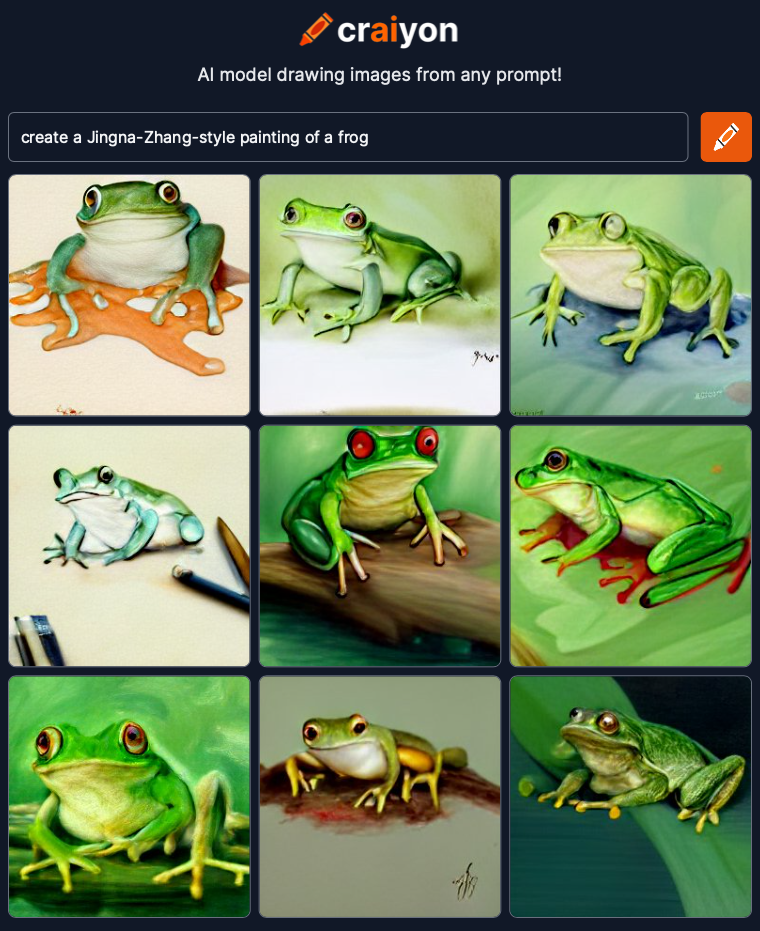
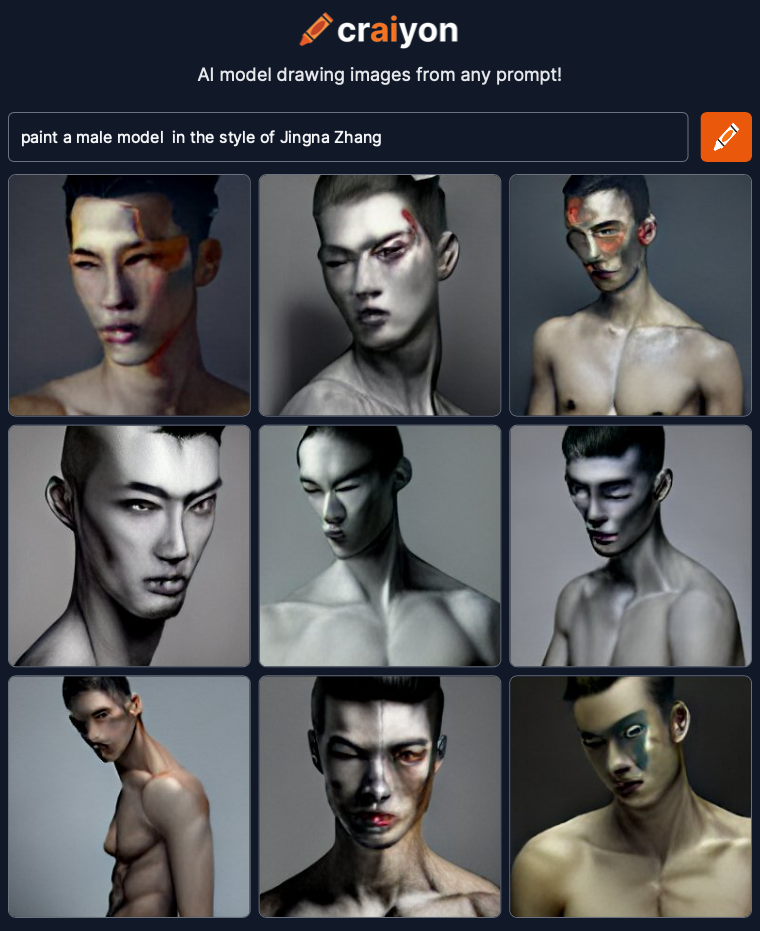
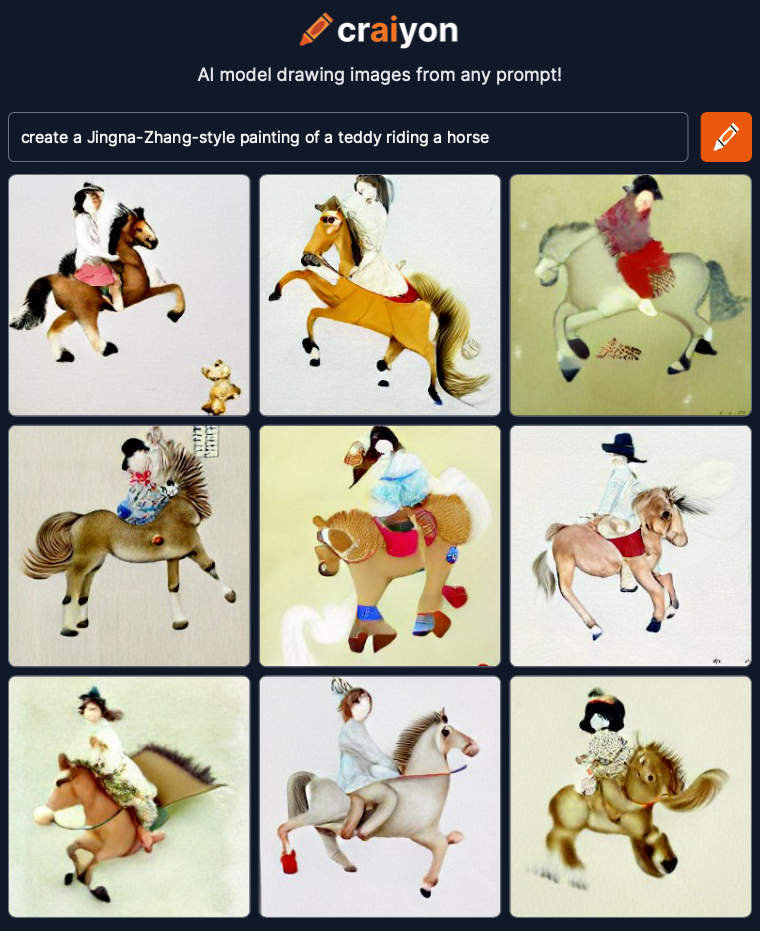
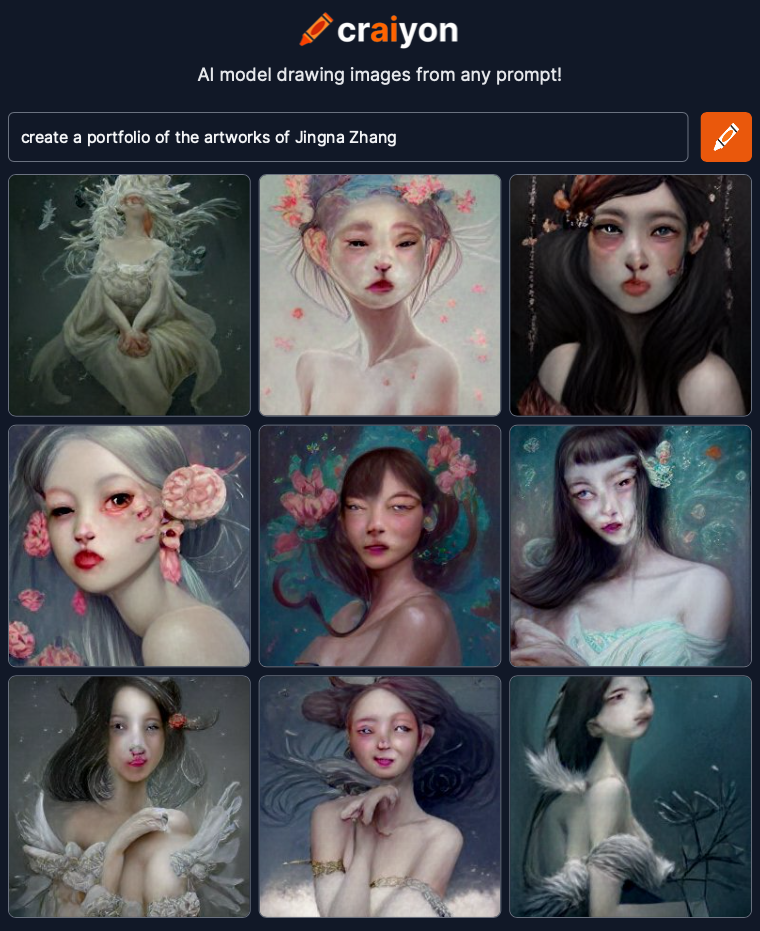
Crayon alias DALL-E mini
Boris Dayma initially created and launched DALL·E Mini during a hackathon organized by Hugging Face, in collaboration with Google in July 2021. This community event brought together around 800 participants, during which Boris Dayma built the first iteration of what would become a viral, open-source text-to-image model. This image generator was based on smaller, open-source AI models like VQGAN and CLIP. It was trained on publicly available datasets. It brought AI art to the masses long before full access to other image generators like DALL·E 2, Midjourney, or Stable Diffusion was common.
After it gained popularity, OpenAI reportedly asked them to rebrand to avoid misleading people that it was affiliated with, or endorsed by, OpenAI. The project was renamed Crayon, a simple and amicable rebranding, without a legal lawsuit.