- HTML
- Java
- Javascript
- NodeJS
- Processing
- Python
Documentation
Lux-ASR: Speech to Text System
The University of Luxembourg provides and Automatic Speech Recognition System (ASR) for Luxembourgish and several other languages (english, french, german, portuguese and spanish). Four output formats are available : plain text (txt), SubRip Subtitles (srt), JSON (with or without time codes for words) and Praat TextGrid. As an experimental feature for the Luxembourgish text translation to other languages has been added, which will output the recognized text in English, French, German, Portuguese, and Spanish.
The speech to transcribe can be recorded from a microphone or uploaded as Audio or Video file. If the recording contains more than one speaker, setting diarization to “On” will separate the text of every speaker in the recording along with time codes for their turns.
API Access
Lux-ASR can also be accessed by API and can be reached via:
curl -X POST "https://luxasr.uni.lu/v2/asr?diarization=Enabled&outfmt=text" \
  -H "accept: application/json" \
  -F "audio_file=@PATH/TO/AUDIO FILE;type=audio/wav"
The API returns the transcription in the specified output format.
Query Parameters
- diarization: Can be set to
Enabled(default) orDisabledto include or exclude speaker diarization. - outfmt: Specifies the output format. Supported values are:
text– plain text transcript (default)json– detailed JSON outputsrt– SubRip subtitle formattextgrid– Praat TextGrid format
Accepted audio formats are .wav, .mp3, and .m4a.
Python Script
Below is a basic Python script that replicates the functionality of the curl command with added flexibility. You can specify the audio file and optionally choose whether to enable diarization and which output format to use.
import requests
import argparse
import os
import sys

def main():
    parser = argparse.ArgumentParser(
        description="Send an audio file to the LuxASR API for transcription."
    )
    parser.add_argument(
        "audio_file",
        type=str,
        help="Path to the audio file (.wav, .mp3, .m4a)"
    )
    parser.add_argument(
        "--diarization",
        choices=["Enabled", "Disabled"],
        default="Enabled",
        help="Enable or disable speaker diarization (default: Enabled)"
    )
    parser.add_argument(
        "--outfmt",
        choices=["text", "json", "srt", "textgrid"],
        default="text",
        help="Output format: text, json, srt, or textgrid (default: text)"
    )

    args = parser.parse_args()

    if not os.path.isfile(args.audio_file):
        print(f"Error: File '{args.audio_file}' not found.")
        sys.exit(1)

    url = f"https://luxasr.uni.lu/v2/asr?diarization={args.diarization}&outfmt={args.outfmt}"
    headers = {
        "accept": "application/json"
    }

    # Determine MIME type
    ext = args.audio_file.lower()
    if ext.endswith(".wav"):
        mime_type = "audio/wav"
    elif ext.endswith(".mp3"):
        mime_type = "audio/mpeg"
    elif ext.endswith(".m4a"):
        mime_type = "audio/mp4"
    else:
        mime_type = "application/octet-stream"

    with open(args.audio_file, "rb") as audio:
        files = {
            "audio_file": (os.path.basename(args.audio_file), audio, mime_type)
        }
        response = requests.post(url, headers=headers, files=files)

    print(response.text)

if __name__ == "__main__":
    main()
Usage
python luxasr_transcribe.py path/to/your_audio.wav --diarization Enabled --outfmt json
Replace path/to/your_audio.wav with your actual audio file. The --diarization and --outfmt options are optional and default to Enabled and text respectively.
Lux-ASR is under constant development by Peter Gilles, Nina Hosseini-Kivanani, and Léopold Hillah at the University of Luxembourg and is supported by the Chambre des Députes du Grand-Duché de Luxembourg.
Disclaimer
Note that the transcription and the translation are run on a dedicated server at the University of Luxembourg. All data thus stays within Luxembourg and the University’s network. Nobody has access to the uploaded audio or the text output. The audio data is streamed to this server and no files are stored on this server or in the network. No data is used to further train the model and no data is transferred to third parties.
Domain Names
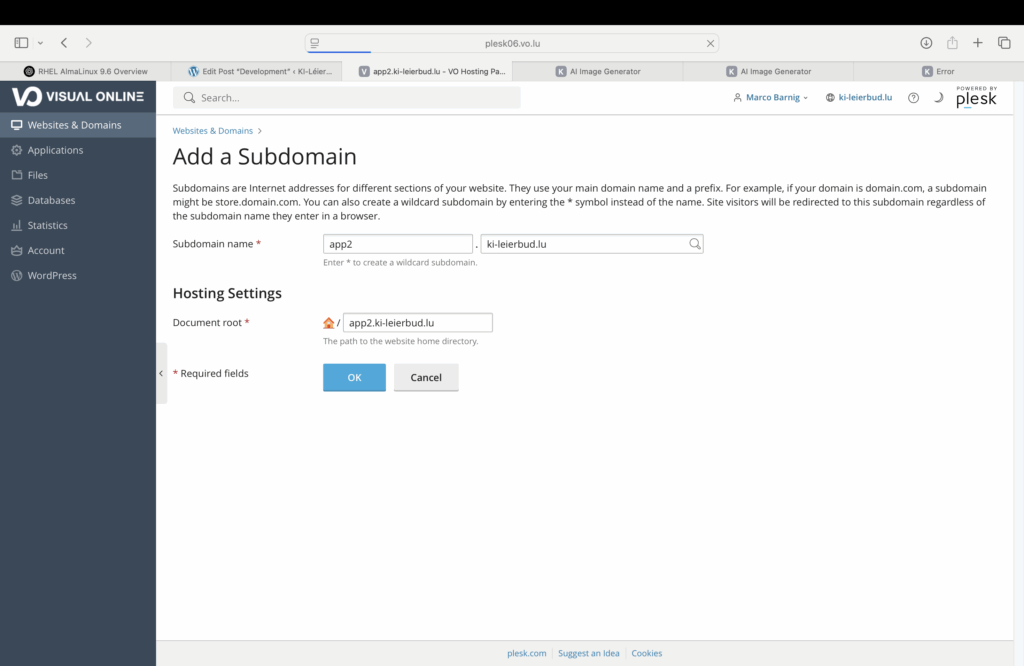
The main domain-name for the KI-Léierbud is ki-leierbud.lu with the following sub-domains :
- admin (homepage WordPress)
- app1 (NodeJS Application)
- app2 (NodeJS Application)
The following screenshot shows the configuration of a subdomain in the Plesk Dashboard :
The following sub-domains will be added if required :
- app3, app4, app5, … (NodeJS applications)
- python1, python2, python3, … (Python applications)
- gradio1, gradio2, gradio3, … (Gradio applications)
- …..
IP – Adresses
KI-Léierbud Server :
- v4 : 85.93.210.152
- v6 : 2001:1610:0:9::152
DNS-Server : Visual Online
Visual Online DNS resolver servers:
- Resolver 1 IPv4: 80.90.44.25
- Resolver 1 IPv6: 2001:1610:0:3::25
- Resolver 2 IPv4: 85.93.210.60
- Resolver 2 IPv6: 2001:1610:0:13::60
URL Shortener : TinyURL
quiz ? : https://tinyurl.com/3hy6aax4
Plesk SSH-Terminal
AlmaLinux 9.6
AlmaLinux 9.6, codenamed “Sage Margay,” was released on May 20, 2025. As a downstream rebuild of RHEL 9.6, it offers full binary compatibility while also introducing unique enhancements:AlmaLinux OS+4Facebook+4wiki.almalinux.org+4
- Kernel Version: Ships with Linux kernel 5.14.0-570.12.1.el9_6.wiki.almalinux.org+2wiki.almalinux.org+2Wikipedia+2
- Extended Hardware Support: Includes a tech-preview of KVM virtualization support for the IBM Power architecture, addressing the needs of specific user groups. wiki.almalinux.org
- Updated Development Tools: Features updated versions of development tools and module streams, such as Apache HTTP Server 2.4.62, Node.js 22, Nginx 1.26, PHP 8.3, MySQL 8.4, and Maven 3.9. AlmaLinux OS+2Linuxiac+2AlmaLinux OS+2
- System Toolchain Upgrades: Incorporates GCC 11.5, LLVM-Toolset 19.1.7, Go-Toolset 1.23.6, and Rust-Toolset 1.84.1, enhancing performance and compatibility.
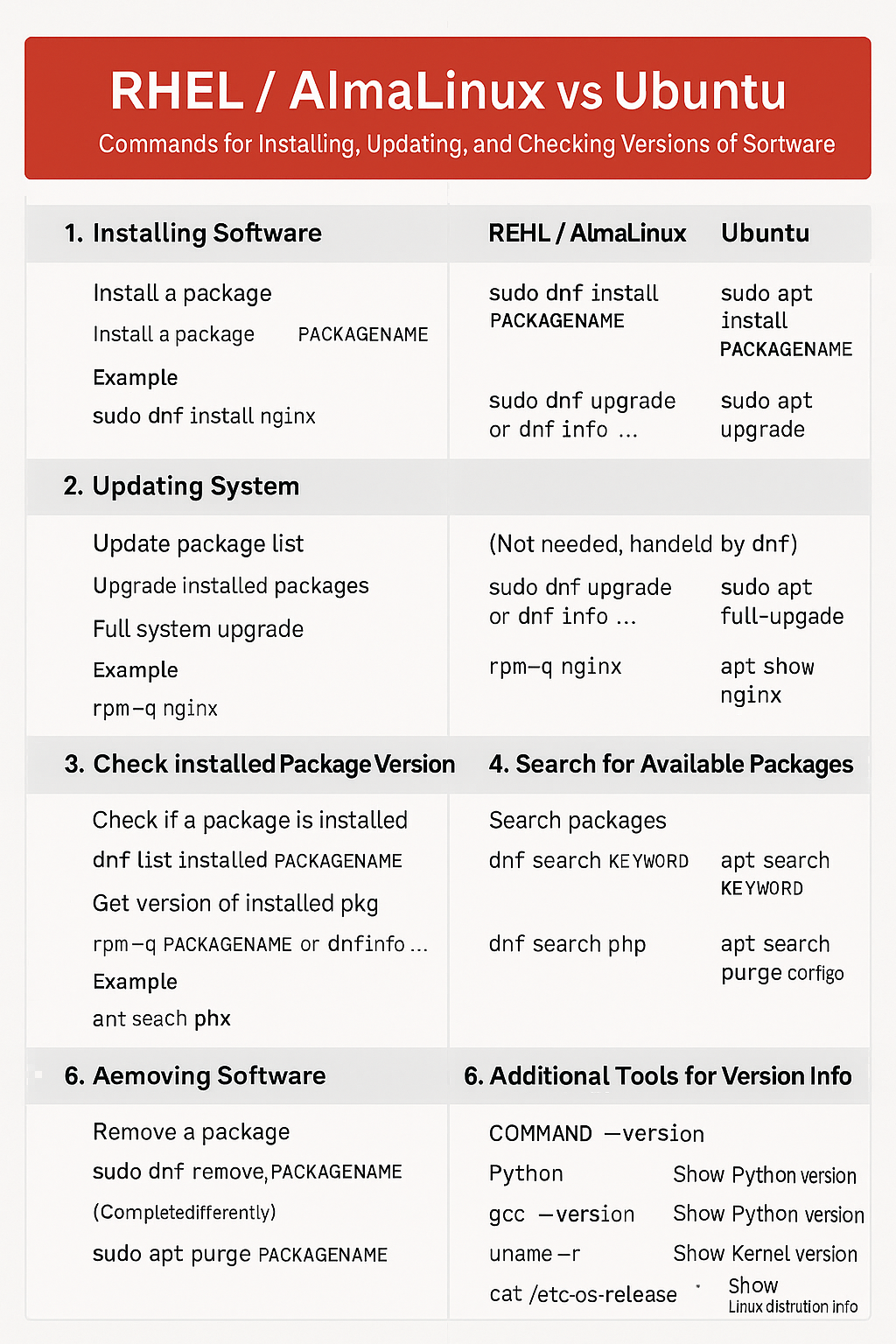
Some AlmaLinux commands are different from Ubuntu which I use on my desktop computers. I asked ChatGPT to generate a cheat sheet comparing commands between the two systems.
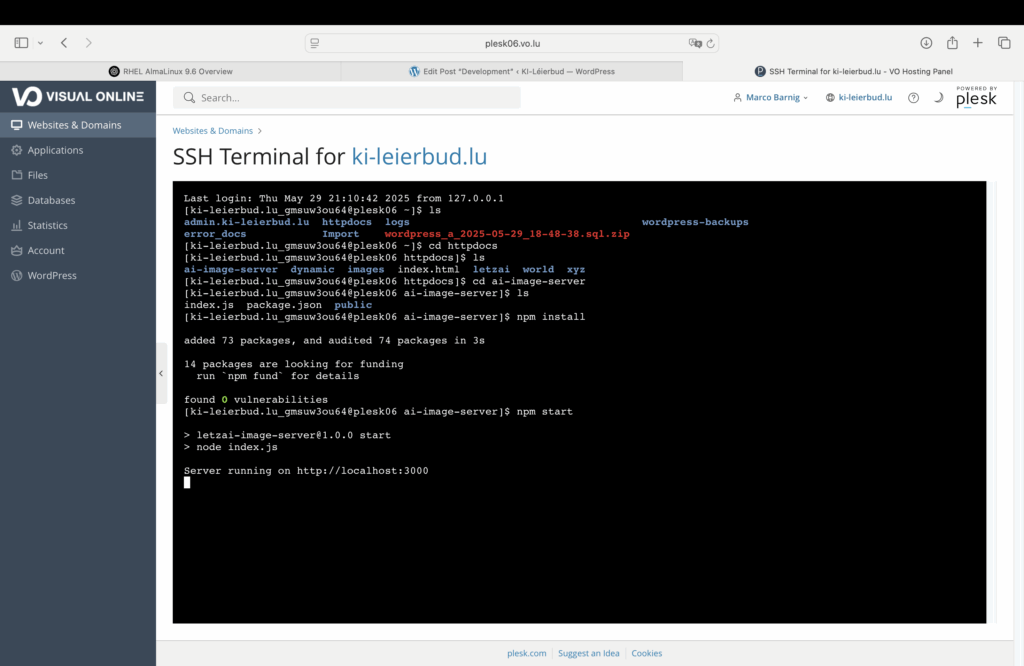
Here is a screenshot of the entries in the Plesk SSH Terminal to install a node app :
Language Handling
The free version of the WordPress Polylang plugin does not include the language support in the REST API. With the assistance of ChatGPT-4o I added the following php-code at the end of the theme functions.php file :
add_action( 'rest_api_init', function () {
    register_rest_field( 'post',
        'translations',
        array(
            'get_callback' => function( $post_arr ) {
                return function_exists( 'pll_get_post_translations' )
                    ? pll_get_post_translations( $post_arr['id'] )
                    : null;
            },
            'schema' => null,
        )
    );
});
Here is the resulting JSON response when fetching a WordPress post in english, with translations in fr, de, pt and lb.
{"id":12,
"date":"2025-05-24T14:28:53",
"date_gmt":"2025-05-24T14:28:53",
"guid":{"rendered":"https:\/\/admin.ki-leierbud.lu\/?p=12"},
"modified":"2025-05-27T14:14:38",
"modified_gmt":"2025-05-27T14:14:38",
"slug":"ki-leierbud-what",
"status":"publish",
"type":"post",
"link":"https:\/\/admin.ki-leierbud.lu\/archives\/12",
"title":{"rendered":"KI-L\u00e9ierbud. What?"},
"content":{"rendered":"\n<figure class=\"wp-block-image size-full\"><img loading=\"lazy\" decoding=\"async\" width=\"1024\" height=\"1024\" src=\"https:\/\/admin.ki-leierbud.lu\/wp-content\/uploads\/what.png\" alt=\"\" class=\"wp-image-23\" srcset=\"https:\/\/admin.ki-leierbud.lu\/wp-content\/uploads\/what.png 1024w, https:\/\/admin.ki-leierbud.lu\/wp-content\/uploads\/what-300x300.png 300w, https:\/\/admin.ki-leierbud.lu\/wp-content\/uploads\/what-150x150.png 150w, https:\/\/admin.ki-leierbud.lu\/wp-content\/uploads\/what-768x768.png 768w\" sizes=\"auto, (max-width: 1024px) 100vw, 1024px\" \/><\/figure>\n\n\n\n<p>KI-L\u00e9ierbud is an interactive web portal aimed at the general public, with the goal of making artificial intelligence (AI) accessible and understandable.<br>This site will offer educational content, interactive demonstrations, mini-courses, quizzes, and simulators to explain the fundamentals, applications, and ethical issues related to AI.<\/p>\n","protected":false},"excerpt":{"rendered":"<p>KI-L\u00e9ierbud is an interactive web portal aimed at the general public, with the goal of making artificial intelligence (AI) accessible and understandable.This site will offer educational content, interactive demonstrations, mini-courses, quizzes, and simulators to explain the fundamentals, applications, and ethical issues related to AI.<\/p>\n",
"protected":false},
"author":1,
"featured_media":0,
"comment_status":"closed",
"ping_status":"closed",
"sticky":false,
"template":"",
"format":"standard",
"meta":{"footnotes":""},
"categories":[203],
"tags":[],
"class_list":["post-12",
"post","type-post",
"status-publish",
"format-standard"
"hentry","category-leierbud"],
"translations":{"en":12,"fr":71,"de":73,"lb":76,"pt":114},
"_links":{"self":[{"href":"https:\/\/admin.ki-leierbud.lu\/wp-json\/wp\/v2\/posts\/12",
"targetHints":{"allow":["GET"]}}],
"collection":[{"href":"https:\/\/admin.ki-leierbud.lu\/wp-json\/wp\/v2\/posts"}],
"about":[{"href":"https:\/\/admin.ki-leierbud.lu\/wp-json\/wp\/v2\/types\/post"}],
"author":[{"embeddable":true,"href":"https:\/\/admin.ki-leierbud.lu\/wp-json\/wp\/v2\/users\/1"}],
"replies":[{"embeddable":true,
"href":"https:\/\/admin.ki-leierbud.lu\/wp-json\/wp\/v2\/comments?post=12"}],
"version-history":[{"count":4,
"href":"https:\/\/admin.ki-leierbud.lu\/wp-json\/wp\/v2\/posts\/12\/revisions"}],
"predecessor-version":[{"id":437,
"href":"https:\/\/admin.ki-leierbud.lu\/wp-json\/wp\/v2\/posts\/12\/revisions\/437"}],
"wp:attachment":[{"href":"https:\/\/admin.ki-leierbud.lu\/wp-json\/wp\/v2\/media?parent=12"}],
"wp:term":[{"taxonomy":"category",
"embeddable":true,
"href":"https:\/\/admin.ki-leierbud.lu\/wp-json\/wp\/v2\/categories?post=12"},{"taxonomy":"post_tag",
"embeddable":true,
"href":"https:\/\/admin.ki-leierbud.lu\/wp-json\/wp\/v2\/tags?post=12"}],
"curies":[{"name":"wp",
"href":"https:\/\/api.w.org\/{rel}",
"templated":true}]}}Useful Links
Links to AI Topics
- Google AI Video Just Changed Everything
- AI Secret
- Facebook AI Video Community
- Using Pipedream MCP with OpenAI
- Vibe Coding
- Study 3D computer animation and visual storytelling
- Evolution of Interfaces
- 25 examples of research with impact: A solid foundation for artificial intelligence
- IA – tendance ou transformation? Le point de vue de Jens Kreisel
- Hack.lu 2025
- EU OSfor the public sector
- Filtered.com (How People are Really Using Generative AI Now)
- Médiation scientifique ludique autour de l’IA
- European Commission – Cookies Policy
- Generative AI Outlook Report
- FLUX.1 Kontext [dev] – Open Weights for Image Editing
- Meet the Real Trenchard More
- ELIZA Reinterpreted: The world’s first chatbot was not intended as a chatbot at all
- Joseph Weizenbaum’s Original ELIZA
- Accessibilité Numérique
- Deep & InTech
- Classical Rajon
- God of Prompts
- Nine Men’s Morris
- Sondage spontané sur l’utilisation IA au Luxembourg (Quest)
- How People Are Really Using GenAI 2024
- Higgsfield.ai
- Image Prompt Styles
- Foire aux questions du gouvernement canadien : utilisation de l’intelligence artificielle dans l’élaboration des propositions de recherche
- A language model built for the public good by ETH and CSCS
- Introducing gpt-oss by OpenAI
- Silicon Luxembourg : Luxembourg Prepares For Quantum-Ready Econom
- Human in the Loop
- OpenAI Prompt Optimizer
- Culture IA : postmortem
- Turingtest Live
Links to LinkedIn Contributions of Marco Barnig
- I am an interactive avatar (mi 2024)
- OzoBot (2021)
- COVID-19 (2021)
- Dale Lan IBM (2021)
- Louis Ducos de Hauron (2021)
- Carte mentale (2021)
- Google AR (2021)
- Millchen (2022)
- Craiyon (2022)
- STT (2022)
- Translation (2022)
- Wat ass um Bild (2023)
- Dall-E2 portrait Marco (2023)
- War against AI (2023)
- Dall-E2 Marco (2023)
- ChatGPT-3 (2023)
- NFT (2023)
- ChatGPT-3 poem (fin 2023)
- ChatGPT (fin 2023)
- LuxAI (fin 2023)
- AI Hallucinations (fin 2023)
- DANTE AI (2024)
- Steampunk Lamps (2024)
- LetzAI Belval (2024)
- Doublage polyglotte (2024)
- BigBugBunny (2024)
- Mäin Zwilling op 6 Sproochen (2024)
- LetzAI Models (2024)
- Salon virtuel de discussion (2024)
- Superjemp (2024)
- Dog & Toaster Poem (2024)
- Harold Cohen (2024)
- RadioLogist Niedercorn (2024)
- Jean de la Fontaine (2024)
- ChatGPT Croquis (2024)
- POLI (2024)
- ChatGPT discussion about Internet (2024)
- Livre les jeunes explorateurs (2024)
- Picassohead (2024)
- LetzAI Spotlight (2024)
- Artistes luxembourgeois (mi 2024)
- Nabaztag (mi 2024)
- Livre les jeunes explorateurs (mi 2024)
- Les jeunes explorateurs jour 6 (mi 2024)
- Les jeunes explorateurs jour 9 (mi 2024)
- Les jeunes explorateurs RTL (mi 2024)
- Heaven for my Easter Bunny (septembre 2024)
- SMIL (septembre 2025)
- Mona Lisa (septembre 2024)
- Savitar (septembre 2024)
- Koffer-Pitty (septembre 2024)
- TTS (septembre 2024)
- ERNIE-ViLG (septembre 2024)
- Poemes (september 2024)
- Mon avatar interactif dans une réunion Zoom sur le web (fin 2024)
- KI-Léierbud Podcast (fin 2024)
- Illustration de l’état de l’art de l’IA générative et agentique (fin 2024)
- Créations sans Limites (fin 2024)
- Video Jeunes Explorateurs (fin 2024)
- État de l’art de l’IA agentique (fin 2024)
- ALICE (fin 2024)
- Caricature (fin 2024)
- SoDuKo (fin 2024)
- Deux avatars interactifs répondent à toutes question sur le budget de l’État 2025 (début 2025)
- Rube Goldberg Machine (février 2025)
- DeepSeek versus ChatGPT (février 2025)
- Aesthetics (mars 2025)
- Eurovision (mars 2025)
- OpenData (mars 2025)
- Luxembourgish Comics (avril 2025)
- How to make images in ChatGPT (avril 2025)
- Cathode Ray Tube (avril 2025)
- Grok-3 versus ChatGPT-4o (avril 2025)
- De Norwand and d’Sonn : 4 avatars (mai 2025)
- Video Podcast “Accélérer la souveraineté numérique 2030” (19.5.2025)
- Vidéo Podcast en langue luxembourgeoise sur la stratégie du Luxembourg en matière de technologies quantiques (21.5.2025)
- ElevenLabs Now Speaks Lëtzebuergesch (6.6.2025)
- AI Model Apertus (6.9.2025)
- Exposé sur Alexander Graham Bell (7.9.2025)
- Dialogue entre deux développeurs (9.9.2025)
Links to general Topics
- Luxembourg Government Departments
- Luxembourgish Bodies & Administrations – Business
- Charte graphique du Gouvernement
Links to useful tools
Links to Institutions
- EITCI : European IT Certification Institute
- Bridge Forum Dialogue
- Luxinnovation
- KI-Kompetenz-Akademy
- Sécher-Digital
- Facebook KI Kompetenz Akademie
Links to press
Interesting Topics
- How Well Does AI Speak Luxembourgish? LIST Put 54 Models To The Test
Videos
- RELUX 2025 Jens Kreisel
- The Bridge Forum Dialogue : AI – A Technology with Opportunities and Challenges
- Luc Julia sans filtre : l’IA, la tech et les idées reçues
- Let’s make it happen -Super8
- FranceInfo : AI – Laurent Alexandre
- Lovable AI Showdown Recap – What’s the vibe #1
- WEIZENBAUM REBEL AT WORK
- Conversation with @dhh
- RTL Hei Elo Retro
- Keith Lissner on Instagram
AI Applications & Domains
🕰️ Chronological Evolution of AI Applications & Domains
1950s–1960s: Early Exploration
- Game Playing (Chess, Checkers) – Early AI programs like IBM’s Deep Thought origins.
- Mathematical Theorem Proving – Logic-based AI for solving formal problems.
- Symbolic Reasoning / Expert Systems – Knowledge representation using rules.
1970s–1980s: Knowledge Systems & Expert AI
- Expert Systems (e.g., MYCIN for medicine) – Rule-based systems for diagnosis and decision-making.
- Robotics – Primitive robots for navigation and manipulation in constrained environments.
- Natural Language Understanding (limited) – Basic parsing and sentence generation.
- Speech Recognition (early research) – Pattern-based speech decoding.
1990s: Expansion with Computational Power
- Autonomous Vehicles (DARPA early prototypes) – Initial experiments with robot cars.
- Machine Translation (e.g., SYSTRAN) – Used by military and government.
- Fraud Detection – Rule-based and early statistical methods in banking.
- Search Engines (e.g., Google) – AI-powered indexing and relevance ranking.
2000s: Rise of Machine Learning
- Recommendation Systems (Amazon, Netflix) – Collaborative filtering and ML models.
- Spam Detection – Naive Bayes and later ML classifiers.
- Customer Service Chatbots (rule-based) – Scripted assistance.
- Computer Vision (object detection) – For security, manufacturing, etc.
- Social Media Feeds – Algorithms curating content.
2010s: Deep Learning Revolution
- Voice Assistants (Siri, Alexa, Google Assistant) – NLP + speech synthesis.
- Image Recognition (ImageNet breakthroughs) – Convolutional neural networks.
- Autonomous Driving (Waymo, Tesla) – AI-driven perception and decision-making.
- Healthcare Diagnostics – AI for imaging (e.g., tumor detection).
- Translation (DeepL, Google Translate neural models) – Neural machine translation.
- Face Recognition – Security and surveillance.
- AI in Gaming (e.g., AlphaGo) – Strategic gameplay beyond human capability.
2020s: Generative AI & Widespread Integration
- Generative AI (ChatGPT, DALL·E, Midjourney) – Text, image, and code generation.
- Drug Discovery & Molecular Design – Predictive AI for new compounds.
- AI in Education – Personalized learning, tutoring bots.
- Financial Forecasting & Trading – Predictive models and risk analysis.
- Legal Tech (Contract analysis, case prediction) – NLP for document processing.
- HR & Recruitment Tools – Resume screening, candidate ranking.
- Creative Industries (Music, Art, Writing) – Co-creation and automation tools.
- Smart Homes / IoT – AI for automation, energy optimization.
- Climate Modeling & Sustainability – Forecasting and optimization tools.
- Mental Health & Wellness Apps – AI-based therapy chatbots, mood tracking.
📅 AI in Chat – Timeline Placement & Evolution
1990s–2000s: Rule-Based Chatbots
- ELIZA (1966) – One of the first chatbots, mimicked a therapist using pattern matching.
- ALICE (1995) – Advanced rule-based chatbot using AIML (Artificial Intelligence Markup Language).
- Customer Support Bots (late 1990s onward) – Scripted responses on websites and call centers.
2010s: NLP-Powered Assistants
- Smart Assistants (Siri, Google Now, Cortana) – Combined voice recognition and basic dialogue management.
- Facebook Messenger Bots (2016+) – API-based bots for commerce and support.
- Enterprise Helpdesk AI – Chatbots integrated with support tools (e.g., Zendesk, Intercom).
2020s: Generative Chatbots / LLMs
- Transformer Models (BERT, GPT series) – Breakthroughs in conversational understanding and generation.
- GPT-3 (2020) – Major leap in context-aware conversation and open-domain chatting.
- ChatGPT (2022–present) – Widely used conversational AI with memory, context, and multi-turn dialogue.
- Multimodal Chat (e.g., ChatGPT-4 with images, code, etc.) – Integration of text, vision, audio, etc.
- Customer Service Automation (advanced) – AI resolving complex tickets end-to-end.
- Mental Health & Therapy Bots (e.g., Woebot, Replika) – Empathetic, conversational interfaces.
- AI Companions & Role-Play Bots – Social and recreational use of chat AI.
- Corporate & Workflow Integration – Chat AI used inside Slack, Microsoft Teams, etc.
Me : What about agents AI ?
ChatGPT a dit :
Excellent question — AI agents are becoming a core concept in modern AI, especially in 2024–2025, and they deserve a dedicated category or subgroup on your website if you’re presenting cutting-edge applications.
🤝 What Are AI Agents?
AI Agents are systems that:
- Perceive, reason, and act in an environment.
- Often operate autonomously, making decisions and taking actions over time.
- Can combine various AI capabilities (language, vision, tools, planning).
They go beyond chatbots — they are more like digital workers or collaborators.
🧭 Where to Place AI Agents?
You have two good options:
✅ Option 1: Create an 8th Group: “AI Agents & Autonomous Systems”
This is ideal if you want to highlight innovation.
Examples:
- Autonomous Personal Agents: E.g., AutoGPT, BabyAGI, ChatGPT with tools/memory
- Task Executors: Agents that complete tasks (e.g., summarize reports, generate presentations)
- Multi-Agent Systems: Agents that collaborate to solve complex problems (e.g., research assistants)
- AI Agents for DevOps: Code maintenance, test writing, deployment
- AI for Process Automation: Agents that operate workflows across apps (Zapier + GPT-style logic)
✅ Option 2: Subgroup under “Business & Productivity” or “Creative AI”
If you want to keep the main group count low (7), you can feature agents as a highlighted trend inside other groups.
📌 My Suggestion:
Add an 8th group: “AI Agents & Autonomy”
This matches the current trend in AI and helps your site feel forward-thinking.
Me : Are there other fields that are missing ?
ChatGPT a dit :
Yes — while we’ve already covered a broad and solid set of AI domains, there are a few more important fields that you might consider adding to make your website even more comprehensive and forward-looking.
Here are additional fields worth including or at least mentioning, depending on your audience:
🔐 1. Cybersecurity & Threat Detection
AI is used to:
- Detect anomalies in networks (intrusion detection)
- Identify phishing or malware behavior
- Automate incident response
- Monitor dark web for data leaks
➡️ Fits well as a stand-alone group or under Predictive Analytics or Infrastructure AI
🌍 2. Climate, Environment & Sustainability
AI helps:
- Predict weather, natural disasters
- Optimize energy usage in grids or buildings
- Analyze satellite imagery for deforestation, agriculture, pollution
- Model climate scenarios
➡️ Great for educational, scientific, or green-tech audiences
⚖️ 3. Legal & Compliance
AI tools are transforming:
- Contract analysis
- Legal research
- Case law summarization
- E-discovery (scanning large data for legal evidence)
➡️ Could be a subgroup under Business & Productivity or NLP, or a full category for legal tech sites.
🏛️ 4. Government & Public Sector
AI applications include:
- Smart city infrastructure
- Social services (e.g., eligibility screening)
- Fraud prevention in public benefits
- National security intelligence
➡️ Relevant for civic tech or policy-oriented audiences
🎓 5. Education & EdTech
AI used for:
- Personalized learning paths
- Automated grading
- Language learning bots
- AI tutors (e.g., Khanmigo)
➡️ Worth its own group if your site targets learning or schools.
🧠 6. Psychology & Human Behavior
AI is used in:
- Emotion recognition
- Mental health apps (e.g., Replika, Woebot)
- Behavior prediction (marketing, security)
- Cognitive modeling in research
➡️ Could be a niche but impactful category, or part of Healthcare or Creative AI
🎮 7. Games & Entertainment
AI powers:
- NPC behavior
- Procedural content generation
- Game testing automation
- Player experience personalization
➡️ Ideal if your audience includes developers or gamers.
🧾 Summary: Fields You Might Add
| Field | Include If… |
|---|---|
| Cybersecurity | Tech-savvy or enterprise audience |
| Sustainability | Environmental/social focus |
| Legal & Compliance | Legal or enterprise users |
| Government | Policy, smart cities, or civic data interest |
| Education | Schools, learning tools, or edtech audience |
| Psychology | Health, wellness, or human-AI interaction |
| Gaming & Entertainment | Creative or dev-focused site |
Me : Please generate a new list with 10 groups and icons for all sub-fields
ChatGPT a dit :
Absolutely! Here’s a well-organized, modern list of 10 AI application groups, each with a clear icon suggestion and key subfields. This structure is great for a website layout — clean, user-friendly, and visually engaging.
🔟 AI Application Groups for Your Website
1. 🤖 AI Agents & Autonomy
Intelligent systems that perceive, reason, and act on goals over time.
Subfields (with icons):
- 🧠 Autonomous AI Agents (AutoGPT, BabyAGI)
- 🛠️ Task Automation Agents (e.g., project assistants)
- 🤝 Multi-Agent Collaboration (teams of AIs)
- 🧾 Process Automation (e.g., RPA + LLMs)
- 🧭 Planning & Decision-Making Systems
2. 🧠 Natural Language Processing (NLP)
Understanding, generating, and analyzing human language.
Subfields:
- 💬 Conversational AI (Chatbots, Virtual Assistants)
- 🔍 Semantic Search (archive/document search)
- 📄 Summarization & Text Classification
- 🌐 Translation & Multilingual AI
- 🧾 Legal/Contract Analysis
3. 👁️ Computer Vision
AI that interprets and understands visual inputs.
Subfields:
- 👤 Facial Recognition
- 🩻 Medical Imaging Analysis
- 🎯 Object Detection & Tracking
- 🧾 OCR (handwriting, documents)
- 🛰️ Satellite & Aerial Imagery Processing
4. 🎨 Creative & Generative AI
AI that creates new content — visual, textual, musical, or code.
Subfields:
- ✍️ Text Generation (stories, articles, social media)
- 🎨 Image Creation (DALL·E, Midjourney)
- 🎼 Music & Voice Synthesis
- 💻 Code Generation (e.g., GitHub Copilot)
- 🧑🎤 Virtual Characters / AI Avatars
5. 🏥 Healthcare & Life Sciences
AI enhancing diagnostics, treatment, and medical research.
Subfields:
- 🧬 Drug Discovery & Genomics
- 🩻 Medical Image Analysis
- 🧑⚕️ Virtual Health Assistants
- 🧠 Mental Health & Wellness Bots
- 🧾 Clinical Documentation Automation
6. 📊 Predictive Analytics & Forecasting
AI that anticipates trends, behaviors, and future events.
Subfields:
- 💰 Financial Market Forecasting
- 🛒 Sales & Demand Prediction
- 📉 Risk Assessment (insurance, finance)
- ⚙️ Predictive Maintenance (industry, logistics)
- 📈 Behavior Prediction (user, consumer)
7. 💼 Business & Productivity
AI that enhances workflows, decision-making, and operations.
Subfields:
- 📩 Email & Meeting Automation
- 📚 Knowledge Management (Q&A over documents)
- 🧑💼 HR & Resume Screening
- 📈 CRM & Sales Intelligence
- 🧾 Invoice & Document Processing
8. 🛡️ Cybersecurity & Threat Detection
AI that protects digital infrastructure and data.
Subfields:
- 🔐 Anomaly Detection
- 🧠 Behavioral Biometrics
- 🕵️ Threat Intelligence & Hunting
- 🧪 Malware & Phishing Detection
- 🧯 Automated Incident Response
9. 🌍 Environment, Climate & Sustainability
AI that supports environmental protection and climate science.
Subfields:
- 🌦️ Climate Modeling & Weather Prediction
- 🌱 Precision Agriculture
- 🏭 Energy Optimization (buildings, grids)
- 🛰️ Deforestation & Land Use Analysis
- 🔋 Renewable Energy Forecasting
10. 🎓 Education & eLearning
AI that personalizes and enhances learning experiences.
Subfields:
- 👨🏫 AI Tutors & Feedback Systems
- 📚 Adaptive Learning Platforms
- 📝 Automated Grading
- 🌍 Language Learning Bots
- 🤖 Content Recommendation in Courses