Harold Cohen
The father of AARON, a computer painting generator
Harold Cohen was a pioneer at the crossroads of artificial intelligence and the visual arts. In 1972, he created AARON, a revolutionary computer program designed to autonomously generate paintings and drawings. His groundbreaking approach, blending computational creativity with traditional art, earned him international recognition, with works exhibited in numerous prestigious museums around the world. In acknowledgment of his contributions, Cohen received multiple awards throughout his career.
Born in the United Kingdom in 1928, Cohen later moved to the United States, where he shared his expertise and passion for art and technology at the University of California from 1968 until his retirement in 1998. Even after retiring, he remained actively involved in the development of AARON, constantly enhancing its capabilities and complexity. The program, initially developed in C, was later rewritten in LISP in order to take advantage of that language’s powerful features for artificial intelligence development.
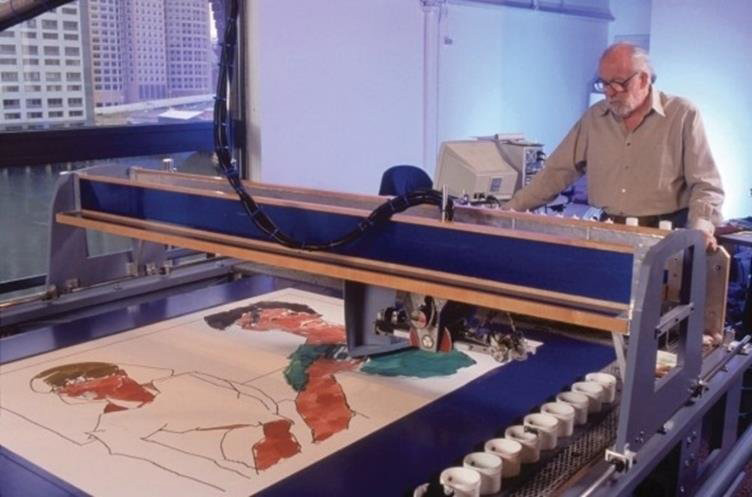
In the weeks leading up to his death in 2016, Cohen embarked on a new ambitious project with AARON, titled “Fingerpainting for the 21st Century.” While in its early years he had used x-y plotters to bring AARON’s creations to life, in the 1990s he developed a series of digital painting machines. This continuous evolution of the medium eventually led him to experiment with inkjet printers and, in his final project, touchscreen displays—always seeking to merge technology with the tactile essence of painting.